

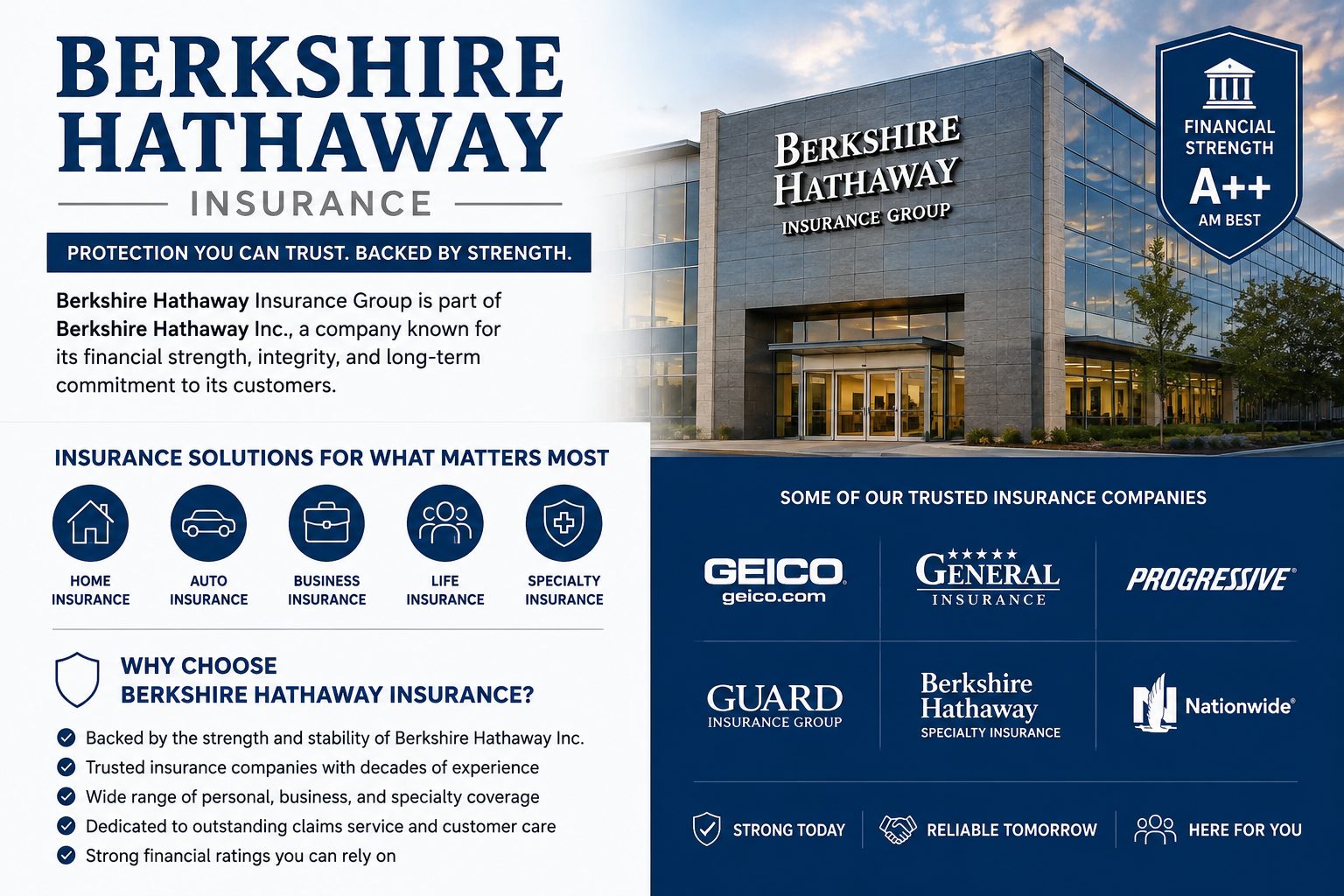
You may know Berkshire Hathaway mainly because of Warren Buffett or due to the variety of businesses it operates and as a result might not be aware of the significance of insurance to the company; so what then can be said about Berkshire Hathaway’s insurance and where does GEICO fit in?
Berkshire Hathaway is not just one insurance company providing a single type of policy; it owns and operates a wide range of insurance businesses, GEICO being the most well-known of those which deal directly with consumers, particularly in the area of auto insurance, while Berkshire’s other insurance activities focus on reinsurance, commercial coverage, specialty risks, workers’ compensation, professional liability and other areas.
The fact that this structure is important is due to the fact that the insurance business makes up a major part of Berkshire Hathaway’s overall business model, and it is for this very reason that someone who buys a GEICO policy is only dealing with one section of a much larger insurance operation.
Table of Contents
How Berkshire Hathaway and GEICO Are Connected
GEICO stands for Government Employees Insurance Company and was set up in 1936, initially offering insurance to government employees and members of the military. Berkshire Hathaway gradually increased its holding and eventually purchased the last of the shares in GEICO in 1996, as a result of which GEICO became a wholly owned subsidiary.
Berkshire Hathaway now owns GEICO as a whole, the group consisting of a number of insurance companies that operate under the GEICO name, including the Government Employees Insurance Company, the GEICO Indemnity Company, the GEICO General Insurance Company and others.
What consumers care about is the fact that GEICO is the insurance brand which handles customers, Berkshire Hathaway being the parent company of GEICO.
It’s just as if a large corporate organization runs a number of different specialized businesses rather than selling all of its products through one company.
What does GEICO insurance include?
GEICO is mainly known for its auto insurance, and that aspect still forms the basis of its insurance operations. According to Berkshire Hathaway’s 2025 annual report, GEICO mainly provides property and casualty insurance for private passenger cars in all 50 states as well as the District of Columbia.
The number of different types of coverage that a typical GEICO car insurance policy has will depend on the policy and the state.
Liability coverage can help out with the costs of injuries or damage to other people’s property in cases where you are legally at fault in an accident.
Collision coverage will assist you in covering the cost of any damage to your vehicle should it collide with another vehicle or object.
A comprehensive insurance policy can provide coverage for losses that are not caused by a collision, such as theft, vandalism, fire or other events which are specified as covered.
Coverage for drivers who are uninsured or underinsured can provide protection in some accidents involving a driver who has no insurance or who has insufficient coverage.
There is also the option of medical payments or personal injury protection, along with roadside assistance, rental reimbursement and coverage for special equipment; the conditions and requirements for this kind of coverage vary from state to state.
GEICO also provides or arranges insurance for motorcycles, ATVs, RVs, boats, houses, tenants, condos, businesses and all other requirements. There is, however, an important difference: not all the policies advertised by GEICO are actually underwritten by the GEICO insurance company.
GEICO Is More Than a Car Insurance Brand
Although GEICO is mainly linked with car insurance, the range of its products is wider.
GEICO provides motor vehicle insurance, including that for motorcycles, ATVs, RVs, and boats. The company also gives information and access to people seeking homeowners’, renters’, condo., co-op., and mobile-home insurance, as well as offers products such as umbrella, life, flood, overseas, and business insurance.
It is important to make the distinction between offering and underwriting.
When an insurance company underwrites a policy, the insurer is assuming the financial risk specified in the contract and GEICO’s insurance agency is able to obtain policies from insurers not directly affiliated with it for products which are not themselves written by GEICO companies.
For instance, a person going to GEICO to obtain home insurance might be offered coverage from a different insurance company via the GEICO Insurance Agency. It is therefore necessary to check the actual insurer and the terms of the policy as well as their availability before making a purchase.
Which other insurance companies does Berkshire Hathaway own?
Berkshire Hathaway’s insurance activities include GEICO.
The 2025 annual report of the company lists a number of large insurance groups, such as GEICO, the Berkshire Hathaway Reinsurance Group, General Re and the Berkshire Hathaway Primary Group.
General Re
General Re, usually referred to as Gen Re, puts a strong emphasis on reinsurance.
Reinsurance is basically insurance taken out by insurance companies; rather than selling a policy directly to an individual driver or homeowner, a reinsurer agrees to take on part of another insurer’s risk.
For instance, if an insurance company has a large number of property policies it might transfer some of its possible losses to a reinsurer in return for paying a premium. This in turn helps the first insurer to deal with very large or highly concentrated risks.
Berkshire Hathaway makes use of General Re as one of its main reinsurance activities, which means the company is exposed to insurance risks in addition to those covered by the policies it sells directly to consumers.
Berkshire Hathaway Reinsurance Group
Another major component of the firm’s’s reinsurance activities is the Berkshire Hathaway Reinsurance Group.
Rather than focusing on standard consumer insurance, reinsurance businesses could handle large, complex or specialized risks transferred from other insurers and reinsurers. Berkshire’s insurance operations have historically included both property-and-casualty reinsurance and life and health reinsurance activiThe way the insurance business operates in Berkshire is quite different from the process of purchasing a car policy from GEICO online.online.
Berkshire Hathaway Primary Group
Berkshire Hathaway Primary Group brings together independently managed insurance companies supplying a wide range of primarily commercial coverages.
According to Berkshire’s 2025 annual report, these businesses include insurance for areas such as healthcare professional liability, workers’ compensation, automobile, general liability, property and specialty risks. The group includes businesses such as Berkshire Hathaway Specialty Insurance, RSUI, CapSpecialty, Berkshire Hathaway Homestate Group, MedPro, GUARD and others.
Berkshire’s involvement in the insurance sector becomes considerably wider here than with consumer auto insurance.
A company may be required to have workers’ compensation insurance for its employees, commercial auto insurance for its company vehicles, professional liability insurance since it is a specialised profession, or general liability coverage. Various subsidiaries of Berkshire are able to deal with different kinds of commercial risks.
Why Berkshire’s Insurance Model Is Different
A reason why Berkshire Hathaway’s insurance activities are so notable is the way in which underwriting and investing are combined.
Insurance companies receive the premiums before they know precisely how much they will eventually have to pay out in claims, and the amount kept between the time premiums are collected and claims are made is usually known as insurance float.
While it is waiting for the claims to be settled, Berkshire can invest its insurance funds, provided that it complies with the relevant insurance rules and obligations. The importance of insurance to Berkshire therefore extends well beyond that of simply earning underwriting profits.
But there is one thing to bear in mind: insurance is still a risk-based industry. It is possible to suffer substantial losses due to poor underwriting, and the results of investments can also vary.
The Berkshire model is therefore based on careful underwriting, a large amount of capital and the capability of managing risks over long periods.
How GEICO’s Insurance Business Fits Into Berkshire
GEICO is of particular importance since it operates on a large consumer scale.
The annual report for 2025 issued by Berkshire indicates that GEICO collected $45.193 billion in premiums during that year and achieved pre-tax underwriting earnings of $6.824 billion. These numbers refer to the performance of GEICO’s insurance underwriting business and must not be taken as an indication of the amount that an individual customer will pay.
GEICO generally sells its policies straight to consumers, unlike some of Berkshire’s commercial insurance operations which usually act through agents and brokers.
For the single driver, the Berkshire connection is mostly out of sight. Instead of dealing directly with Berkshire Hathaway’s head office, you usually deal with GEICO and the particular GEICO insurance company listed on your policy.
Does the fact that Berkshire Hathaway provides insurance mean that you get Berkshire’s coverage?
Not exactly.
It is a vital point for anyone who is comparing insurance companies.
Berkshire Hathaway is the parent company, but the insurance policies are issued by particular insurance companies. The policy itself will state the name of the insurer as well as the coverage limits, the exclusions, the deductibles and all other terms that apply.
For your argument, the details are more important than just the fact that Berkshire Hathaway owns the company.
For instance, two people might both say that they have ‘Berkshire Hathaway insurance’, but one could in fact have a GEICO car policy while another business has insurance from a Berkshire Hathaway Specialty Insurance company. The insurance products in these two cases are quite different and are intended for different types of risk.
What concern is there regarding homeowners’ and renters’ insurance from GEICO?
GEICO can assist customers in getting homeowners’ insurance, renters’ insurance and other types of property insurance, but consumers ought to be careful about the company that actually underwrites the policy.
GEICO says that its insurance agency collaborates with independent insurers for some of its products, which implies that the insurer listed on the policy might not be one of Berkshire Hathaway’s insurance companies.
Coverage also differs from state to state and from policy to policy. For example, a standard homeowners policy might include coverage for the structure of the house, for the contents and for certain liability risks, but there are exclusions and limits in place. In the case of flood and earthquake damage, separate coverage may be needed depending on the situation and the policy.
When you’re looking around at GEICO, don’t just look at the brand name; read the real policy details and check the underwriting company.
Pros and Cons of Berkshire Hathaway’s Insurance Approach
There are certain real benefits to be had from having such a large insurance company supporting brands like GEICO.
The company has gained experience in both consumer and commercial insurance, as well as in primary insurance and reinsurance, and its multiple business operations are managed separately within different insurance markets so that specialists can concentrate on specific risks.
The problem for consumers is that the structure of Berkshire Hathaway can be confusing, since “Berkshire Hathaway insurance” does not refer to a single standard consumer policy; instead, different subsidiaries offer different products and GEICO may arrange certain products via external insurers.
That makes it important to compare the actual policy rather than relying on the parent company’s name.
Is GEICO identical to Berkshire Hathaway?
GEICO is entirely owned by Berkshire Hathaway.
GEICO runs its own insurance companies and offers insurance policies under the GEICO name. GEICO is owned by Berkshire Hathaway as part of the conglomerate’s wide range of insurance and non-insurance businesses.
Does Berkshire Hathaway carry on the direct sale of insurance to consumers?
Although Berkshire Hathaway has a number of insurance companies, ordinary people usually deal with particular subsidiaries and brands rather than purchasing a general ‘Berkshire Hathaway policy’.
GEICO is the best-known consumer brand within the company. The rest of Berkshire’s businesses deal with commercial insurance, specialty insurance and reinsurance.
Does GEICO only offer auto insurance?
The main thing the company does is provide auto insurance, but it also offers or helps arrange access to a number of other kinds of insurance, including motorcycle, homeowners’, renters’, boat, RV, umbrella, and business insurance. Nevertheless, the availability and the underwriting arrangements vary depending on the type of policy and the state.
Does GEICO offer insurance coverage for each of the policies it sells on its website?
The company states that some of its policies are arranged through independent insurance companies. In the case of a policy which is outside GEICO’s main field of insurance business, you should check the name of the actual insurer and go through the policy documents.
Before you decide to purchase insurance from GEICO, what should you check?
Begin with the coverage that you really need rather than focusing on the brand name. You should compare the liability limits, the deductibles, the exclusions and the optional coverages. Ensure that the quotations are based on similar limits and deductibles, and don’t forget that state requirements and prices can differ.
For home or specialty insurance arranged through an agency, also check which company will actually issue the policy.
The Bottom Line
Berkshire Hathaway insurance is better understood as a large family of insurance businesses rather than one consumer insurance company. GEICO is the group’s most recognizable consumer insurer, with auto insurance at the center of its business, while General Re, Berkshire Hathaway Reinsurance Group and Berkshire Hathaway Primary Group serve very different insurance markets.
For shoppers, the Berkshire Hathaway connection can be useful context, but it should not replace reading the actual policy. The insurer named on your contract, the coverage limits, exclusions, deductibles and state-specific rules ultimately determine what protection you have.
Information in this article is for general educational purposes. Insurance products, underwriting companies, eligibility, coverage, limits and pricing can vary by state and individual circumstances. Always review the applicable policy documents and obtain current information directly from the insurer before making an insurance decision.


