

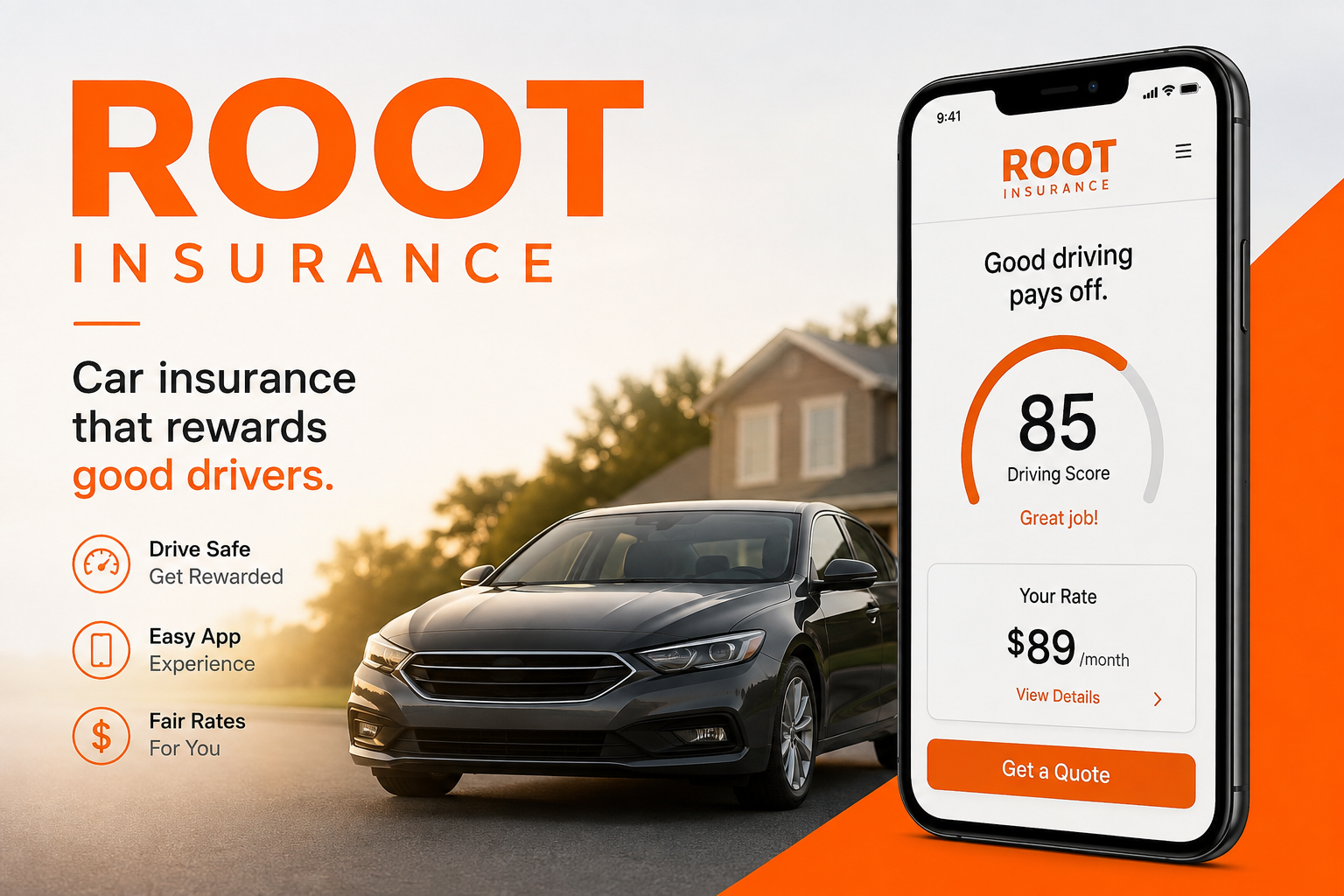
Of course. Root Insurance means that the way you drive has a direct effect on the amount of your car insurance premium. Instead of relying mainly on conventional rating factors, Root uses telematics technology to evaluate your driving behaviour through its app and other connected data sources. The driving data that you supply can then be combined with other rating factors in order to determine your eligibility and to set your premium.
Root is unlike a conventional insurer in that your driving habits are not something which the company considers after an accident has occurred or at the time of renewing the policy; rather, they can be a major factor in the pricing right from the beginning.
Table of Contents
How Root Insurance Uses Your Driving Data
Root makes use of a form of usage-based insurance called telematics. In simple terms, telematics consists of collecting information about how, where, and when a vehicle is driven and then using that information to assess the level of risk.
Previously Root has acquired driving-related information by making use of the sensors in the driver’s smartphone, and the information it now provides also includes data from connected vehicles as one of the methods it has for obtaining such information, on the condition that the driver gives their consent in the appropriate cases.
For drivers completing Root’s test drive, the app can measure behaviors such as:
- Braking
- Turning
- Speed-related behavior
- Time of day
- Miles driven
- Driving routes
- Focused driving or phone-related behavior
The specific factors used may differ depending on Root’s current underwriting practices and the driver’s state.
What matters is that Root is not only interested in finding out whether you have a clean driving record but is also attempting to evaluate your actual behaviour behind the wheel.
What is the root test drive?
For many drivers the process starts by taking a test drive with the Root app.
Root suggests that drivers should take their phone with them and continue to drive as they usually do. The company assesses driving behaviour and then sets a rate for eligible customers on the basis of the data it gathers during the test-drive period. The company’s present frequently asked questions (FAQ) page states that the test drive lasts approximately three weeks, while the insurance information given on the first day say it might take up to 30 days.
Root is able to provide insurance on the first day for some eligible customers, and in those cases the first rate will stay in effect for a limited period while the driver carries out the test drive; after that Root will use the results to determine the final rate.
It means that the price you first see isn’t certainly the one you will end up paying.
Might driving safely lead to a reduction in your car insurance premium?
Potentially, yes.
Root says that its rates are primarily based on driving behaviour and that safer driving will lead to greater savings. The fact that this is so does not mean that every driver who gets a good test-drive score will immediately receive a specific price or discount.
Setting insurance prices is more complicated than just relying on a driver’s score, since Root combines data from usage-based insurance with traditional and state-approved rating factors when preparing a quote.
Therefore, two drivers can have identical driving behaviour but still end up with different rates because of differences in things such as the type of vehicle they own, the area in which they live, the coverage choices they have selected, or other rating factors.
The rules concerning availability and rating vary from state to state.
What driving habits are the most important?
Root does not reduce safe driving to a single behavior; rather, the current consumer information provides a number of factors that could be taken into account when working out a quote.
Braking
Frequent or harsh braking could be an indication of risk, but smooth braking—when the circumstances require it—is generally in keeping with the kind of driving behaviour that telematics systems are meant to assess.
You must not delay in applying heavy braking when it is necessary for safety; for example, if a child runs into the road then urgent braking is the right thing to do.
Turning
The programme can evaluate the way you take your turns, treating sharper or more aggressive ones differently from smoother ones.
The situation is important since the purpose of the system is to evaluate driving styles not just by rating each individual action as good or bad.
Time of Day
Driving can be taken into consideration as part of Root’s assessment, since the factors it refers to in its frequently asked questions (FAQ) specifically involve different times of day.
It is important because the way in which people drive is quite different when they are making a daytime commute from when they are travelling at night.
Miles Driven
The number of miles you drive could also be considered; someone who drives only a few miles each week has a different level of exposure to road risk than a person who spends several hours driving every day.
Root lists the distance travelled as one of the factors used in the calculation of its quote.
Phone Use and Focused Driving
Root has also stated that forms of driving which involve distraction or the use of a phone are included in the data which its telematics technology can evaluate.
This aspect has to be considered by someone who is using a smartphone insurance scheme. The app does not simply look at the force with which you brake or the sharpness of your turns; it can also assess aspects of concentrated driving.
What result would there be if your driving was not good?
A principal difference between Root and a normal quote process is the following.
Root is not simply promising to give each driver a reduced premium; at the moment, if a driver fails to meet the conditions required in order to keep their coverage after the test drive, Root can let the driver know so that they can then look elsewhere for coverage, on the condition that the relevant state laws permit it.
It means, therefore, that the telematics process affects more than just the price.
For example, let’s consider the case of two drivers asking for quotations. Driver A generally brakes smoothly, avoids distracted driving, and has driving habits that are relatively low in risk. Driver B, by contrast, often drives aggressively and has more risky driving styles.
The two drivers cannot simply suppose that they are going to achieve the same result just because their cars are similar; Root’s model is in fact intended to distinguish between drivers on the basis of their observed behaviour.
Does Root ever look at anything other than driving?
Yes.
It is reasonable to assume that Root calculates your entire premium entirely from your driving score, but that is an oversimplification. Root has stated that its pricing method merges telematics or usage-based insurance data with other rating factors, including those which are approved at the state level.
It might therefore be the case that your final premium is determined by other factors than your performance in the test drive.
The kind of cover you take also has an effect; if you select higher liability limits or add any optional cover then the premium will be more than it would be if you had a policy with lower limits or providing fewer protections.
The state is also significant because the rules about motor insurance, the kinds of cover that are required, and the rating factors that are permitted differ from one place to another.
A Simple Example
Imagine yourself being given an initial Root quote and then taking the test drive.
While you are on the test-drive, you should generally drive during the day, avoid unnecessary use of your phone, brake in a smooth manner, and take turns without acting aggressively.
Root may determine that your observed driving behavior supports a favorable rate.
Now imagine another driver with the same vehicle and similar coverage. That driver regularly makes hard stops, drives at riskier times, and shows more distracted-driving behavior.
The two drivers could receive different pricing because Root’s model is designed to incorporate actual driving behavior.
It doesn’t mean that the first driver will definitely end up paying less; since insurance pricing takes into account a number of factors, the rates can differ from state to state and from person to person.
What are the advantages of Root’s driving-based model?
The greatest possible benefit is that your driving habits can make a difference to the rate you pay for your insurance.
For someone who drives carefully, a telematics-based insurer may be appealing because the pricing process attempts to take into account individual driving behavior rather than relying entirely based on broader risk categories.
Root also makes the process highly digital. Quotes, policy management, and other insurance tasks can be handled through its app.
For drivers who are comfortable sharing driving data, that convenience may be attractive.
What Are the Downsides?
The same feature that makes Root different can also be a disadvantage.
First, you have to be comfortable with telematics. If you don’t want an insurer collecting information about your driving through an app or connected vehicle, a driving-based insurance model may not be a good fit.
Second, your driving behavior can work against you. With a traditional insurer, a clean record doesn’t necessarily mean your driving is continuously monitored through an app. With Root, observed driving behavior is an important part of its model.
Third, the initial quote may not tell the whole story if your final rate is determined after the test drive. Drivers should review the eventual policy price and coverage carefully before deciding whether to continue.
Root considers it important to have privacy and says that it does not sell users’ data. Nevertheless, people who are thinking of getting telematics insurance should still look at the company’s present privacy information and understand the data that is collected and the way it is used.
Is Root Insurance a Good Fit for You?
Root may make sense for drivers who are comfortable using an app, willing to participate in telematics, and interested in having their driving behavior have a significant role in pricing.
The option might not appeal to you if you firmly prefer that your driving should not be monitored or if you are looking for a conventional insurance experience that does not involve a driving test or a connected-data element.
The correct decision will ultimately rest on the specific quote, the level of coverage, the deductible, the availability in your state, and your own personal circumstances—not just on the fact that Root’s pricing model seems attractive.
FAQs About Root Insurance
Does Root Insurance really track your driving?
Yes, Root gathers driving information by means of telematics technology. According to its present资料, the app is able to measure behaviours such as braking, turning, the number of miles driven, the time of day, and focused driving.
How long does the Root test drive take?
The current FAQ from Root indicates that the test drive will take about three weeks, whereas the information given on day one states that it could take as long as 30 days; the exact process may differ according to the policy and the circumstances.
Can bad driving increase my Root insurance rate?
Your driving behavior can affect the rate Root calculates. Root says it uses driving information as the main factor in pricing, although other rating variables and state-specific rules can also apply.
Does Root only use my driving score?
No. Root has stated that it combines its usage-based insurance information with other rating variables when determining a quote.
Do I have to use the Root app?
The Root process has consistently relied heavily on its smartphone app for telematics. Root also now supports connected-vehicle data in some circumstances, so the exact process may vary.
The Bottom Line
Root Insurance can make your actual driving a major part of your car insurance rate. Through telematics, Root evaluates behaviors such as braking, turning, mileage, time of day, and focused driving, then uses that information alongside other rating factors to determine pricing.
That can be useful for attentive drivers who are comfortable sharing driving data. But it also means the insurance process isn’t completely passive: how you drive during the test-drive period can matter.
Before buying a policy, compare the final premium—not just the initial quote—and make sure the coverage limits, deductibles, exclusions, and state-specific terms suit your needs.


