

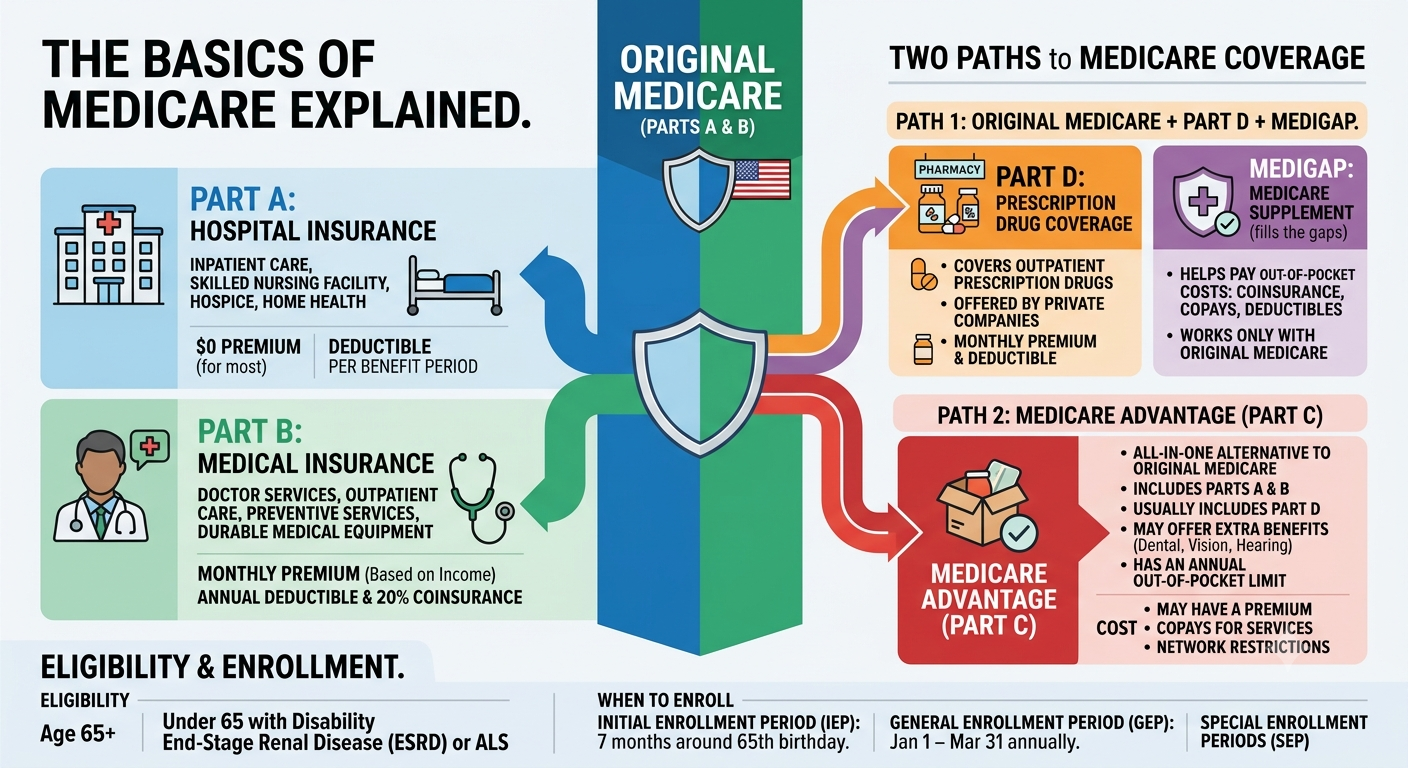
When seniors turn 65 in the United States, they’re excited to enroll in Medicare. Many believe that Medicare provides free, public health insurance to older Americans and that they’re automatically enrolled once their age hits the magic number.
Unfortunately, Medicare isn’t so simple. First, Medicare isn’t free: seniors have to pay a monthly premium to avoid losing coverage just like other forms of health insurance. Likewise, seniors are responsible for some of their healthcare costs with Medicare. Enrollment isn’t automatic either, as seniors need to proactively sign up for Medicare coverage. Finally, Medicare offers numerous options such as Original Medicare and Medicare Advantage Plans that can feel overwhelming to compare.
This article won’t try to sell you a plan, but it will explain the pros and cons of your options to help you make the right decision for your needs. It covers Original Medicare (Parts A and B), Advantage Plans (sometimes called Part C), Medicare prescription drug coverage (Part D), and Medicare Supplement Plans (or Medigap) in layman’s terms. Keep reading if you’ve been searching for a reliable Medicare resource!
Table of Contents
What Is Original Medicare?
Original Medicare refers to the public health insurance option that was passed in 1965. It provides health insurance coverage to American seniors managed by the United States government. Original Medicare is comprised of two Parts: Part A (Hospital Insurance) and Part B (Medical Insurance).
Part A Hospital Insurance
Part A covers inpatient hospital stays, hospice care, stays at skilled nursing facilities, and select forms of home healthcare. If you are a spouse who has at least 10 years and paid Medicare taxes, you won’t have to pay a monthly premium for Part A. Otherwise, your premium is determined by how many years you or a spouse paid Medicare taxes.
The coverage doesn’t kick in until you’ve paid your deductible: $1,632 per inpatient hospital stay in 2024. Since the deductible is per stay, you may have to pay it multiple times in a calendar year. After that, your share of costs will depend on the type of care you’re receiving and how long you stay. For example, you’ll pay 100% for an inpatient hospital stay for the first 60 days after your deductible is paid, a $408 daily copayment for days 61-90, and $816 per day for days 91-150. If you stay in the hospital longer than that, you will be responsible for all costs.
Part A also covers 80% of the approved cost of durable medical equipment such as wheelchairs, walkers, and hospital beds.
Part B Medical Insurance
Part B covers certain doctor services, outpatient care, medical supplies, and preventative services. The average monthly premium for Part B is $174.70 in 2024, though high earners may be required to pay more. You are responsible for paying this premium every month regardless of whether you use your Part B coverage.
You will have to pay an annual deductible of $240 before your Original Medicare coverage kicks in. After that, the plan will pay 80% of the Medicare-approved costs associated with most expenses. Notably, some physicians and health care facilities charge more than the Medicare-approved cost for covered services. You are responsible for the excess created by the higher price.
Certain preventive services such as an annual depression screening and select clinical laboratory services are also available at no cost to you through Medicare Part B.
Original Medicare vs. Medicare Advantage Plans
While Medicare Parts A and B are managed by the government, Medicare Part C allows private health insurance companies to offer competing coverage. By law, all Part C Advantage Plans are required to provide the same coverage as Original Medicare. Most Advantage Plans offer additional benefits as well.
The specific benefits vary from plan to plan, but some of the most common perks include vision and dental coverage, lower monthly premiums, caps on out-of-pocket costs, accessibility stipends, and prescription drug coverage. New Advantage Plans become available every year, and you’ve surely seen lots of advertisements for them.
Medicare Advantage Plans have a marketing budget because they are generally for-profit offerings. All of the benefits listed above come at the cost of limiting yourself to a network of doctors and healthcare facilities the insurer negotiated favorable rates with, allowing the company to make a profit despite offering additional services.


