

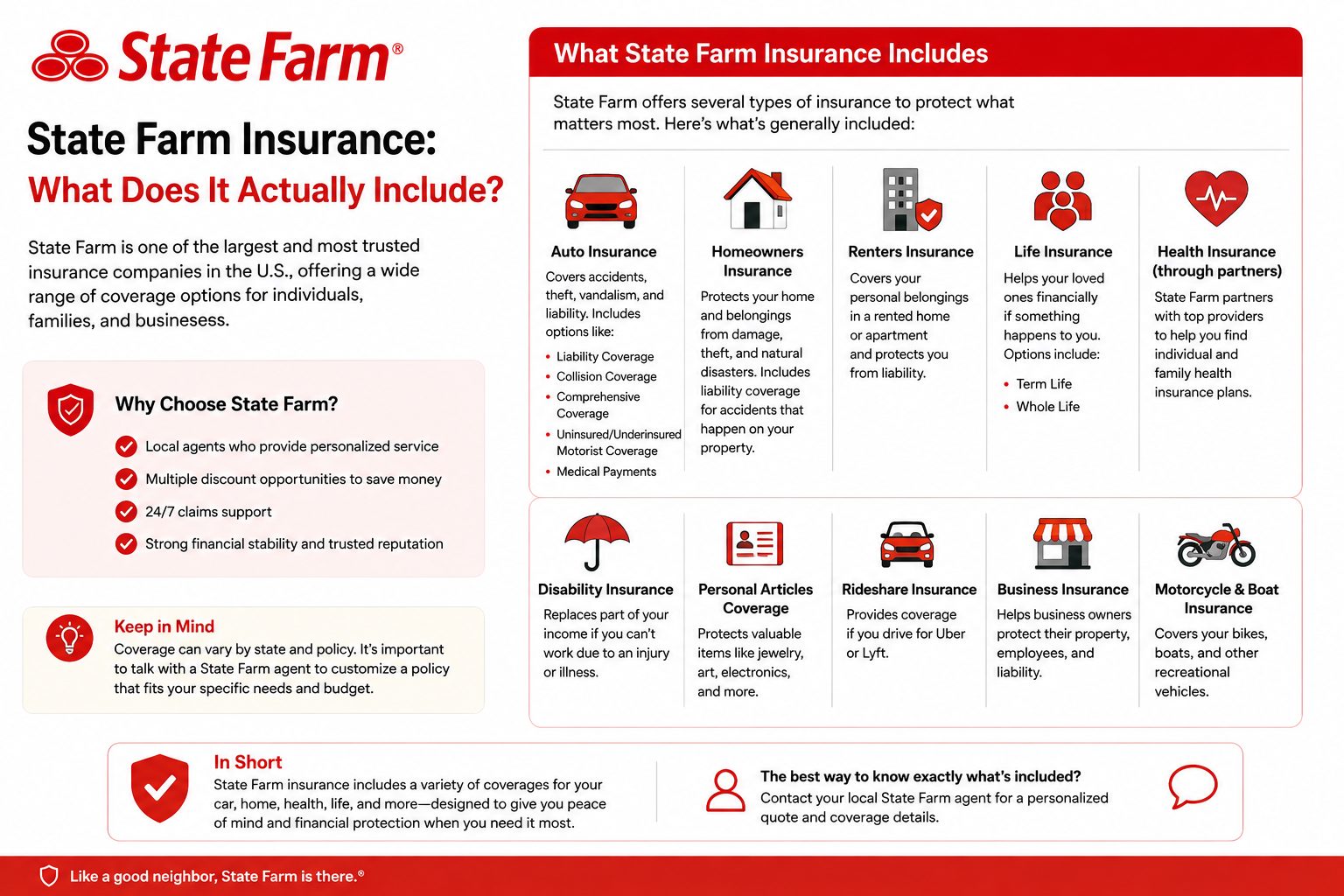
If you are thinking of getting insurance from State Farm, you should realise that there is not a single type of ‘State Farm insurance’. Instead, the company provides various types of insurance, including car, home, renters, life, health, and other coverage. The extent of your coverage will depend on the policy you select, the coverage limits and deductibles you choose, your state and the particular terms of your policy.
The following summary explains what the various types of State Farm insurance usually cover and, just as important, what they might not cover. The sections below explain each type in turn.
Table of Contents
What Does State Farm Auto Insurance Include?
State Farm offers a variety of protection options with its auto insurance. However, the specific combination available and required may differ from state to state.
Liability insurance usually pays for another person’s medical bills, the repair of their vehicle, or damage to their property when you are at fault in an accident. The main purpose of this type of coverage is to protect you from having to suffer financially because you have injured someone or damaged their property.
Collision coverage can help out with the cost of repairing or replacing your vehicle in the event that it is damaged in an accident involving another vehicle or an object. For instance, if you hit a guardrail or another car, the coverage might be used to pay for the repairs, provided that your deductible and the terms of the policy allow it.
Comprehensive cover extends to certain types of damage which result from nothing being caused by a collision, such as theft, fire, vandalism and hitting an animal.
Coverage for uninsured and underinsured motorists can be of assistance in the case where you are injured by a driver who has no insurance or who has insufficient insurance; in some cases, depending on the policy and the state, it may also extend to certain damage to property.
Medical payments coverage might also be offered. It can assist with some of the medical expenses caused by a car accident, according to the policy and the state.
What Auto Insurance Doesn’t Automatically Cover
Just because you have motor insurance doesn’t mean that all kinds of vehicle damage or costs will be covered; your policy could include exclusions, limits, and deductibles. Optional cover may also be needed to protect against damage to your own vehicle.
For instance, liability insurance usually won’t cover the cost of repairing your own car, even if you caused the accident; that’s when coverage like collision coverage might come into play.
What Does State Farm Homeowners Insurance Include?
State Farm home insurance is intended to cover both your house and some of your personal possessions in the event of a covered loss, and it also contains liability coverage.
The main areas of coverage include:
- Dwelling coverage: This provides compensation for damage to the house and all attached structures resulting from covered causes of loss.
- Coverage for personal property helps to protect items such as furniture, clothing, appliances and other movable possessions against theft or damage caused by a covered peril.
- Loss of use: It can be used to help cover extra living expenses in cases where a covered loss makes your home unfit for habitation.
- Personal liability: It may be of some help in protecting you should you be legally responsible for causing bodily injury to another person or for damaging someone else’s property.
- You may offer limited coverage in the case of a guest being accidentally injured on your property.
For instance, if a storm that is covered by your insurance causes damage to part of your house, your dwelling coverage could assist with the cost of the repairs that are covered. If you are required to move out temporarily due to the covered damage, your loss-of-use coverage might help with some additional living expenses.
Does homeowners insurance cover everything?
No, homeowners’ insurance will only pay for losses that fall within the types of loss covered by the policy and its terms.
Some risks will need their own insurance or extra coverage; for instance, flood damage is not something you can simply assume is covered just because you have homeowners insurance.
Protection for valuable possessions may also have certain limits. Therefore, when you own expensive jewellery, collectibles or other high-value items, you ought to check whether the standard policy gives you adequate coverage or whether it is appropriate to get extra coverage.
What Does State Farm Renters Insurance Include?
Renters’ insurance differs from homeowners’ insurance in that it usually provides coverage for the renter’s possessions and for liability rather than for the building.
State Farm states that its renters coverage includes personal property, personal liability, payments for medical expenses incurred by others, and additional living expenses following certain covered losses.
For instance, if a covered fire damages your furniture and electronics, your personal property coverage could help cover the loss. If the rental property becomes unlivable as a result of a covered event, the loss-of-use coverage might help with some of the extra expenses you incur while you are living elsewhere.
Normaly renters’ insurance does not cover the structure of the building since that is usually the landlord’s responsibility.
It by no means includes every possible cause of damage; State Farm explicitly names flooding, certain kinds of water damage, earthquakes, deterioration, pests, and other exclusions or limitations that may apply.
What Does State Farm Life Insurance Include?
Life insurance is different from property insurance since, rather than mainly covering the cost of repairs or replacing damaged property, it gives a death benefit to the beneficiaries on the death of the person who is insured, provided that the policy’s terms and conditions are satisfied.
State Farm provides both term and permanent life insurance, including whole life and universal life.
Term life insurance covers a set period; for instance, State Farm’s Select Term policies offer terms of 10, 20, or 30 years, depending on eligibility and availability in each state.
Whole life insurance is intended to provide coverage for your entire lifetime, provided that premiums are paid as they should be, and it also builds cash value over time.
Universal life insurance is also a type of permanent insurance that provides flexibility regarding premiums, death benefits, and policy account value.
The key thing to realise is that life insurance differs from car or home insurance in that the benefit is linked to the insured’s death and depends on the policy’s particular terms.
Does State Farm provide health insurance?
State Farm does provide some health-related insurance products, but they should not be automatically taken to mean comprehensive major medical health insurance.
Supplemental health insurance and Medicare Supplement insurance are available as part of its current health insurance options. Supplemental health insurance provides specified benefits for covered expenses, and Medicare Supplement insurance helps with some of the costs Medicare does not cover.
The extent of coverage, its availability, and its limitations vary by product and by state, so it is important to consult the policy documents to find out exactly what is covered.
What about insurance for rental property?
A standard homeowners insurance policy might not be suitable for a property you rent out to another person.
State Farm provides insurance for rented homes that can cover certain types of property damage, liability claims, and, in some cases, the loss of rental income resulting from covered losses.
It is not the same as renters insurance, which is intended for renters of homes and apartments.
Why Your State Farm Coverage May Be Different From Someone Else’s
Two individuals can have insurance with State Farm, yet their coverage can be quite different.
That’s because insurance policies can differ based on:
- State regulations
- Type of policy
- Coverage limits
- Deductibles
- Optional coverage and endorsements
- Property or vehicle characteristics
- Individual underwriting factors
- Eligibility and availability
State Farm points out that prices, the range of coverage available, discounts and availability may differ depending on the state and the individual circumstances.
As a result, an online description should be regarded as a general guide, not a replacement for your actual insurance contract.
A Simple Example of How Coverage Works
Suppose that you are the owner of a house and have home insurance from State Farm.
The storm caused a covered tree to fall onto your roof. As a result, your insurance policy could offer coverage for the damage to the dwelling. If the damage makes the home temporarily uninhabitable, the loss-of-use coverage might assist with some of the extra living expenses.
Suppose now that your car has been damaged as a result of colliding with another vehicle; in that case, your liability insurance could assist the other party with their covered losses if you are at fault, and your collision insurance could help with the damage to your own car provided that you have taken out collision coverage.
That point matters because the insurance coverage in question depends on what occurred, which coverage applies, the policy limits, and the exclusions.
What should you check before you buy a State Farm policy?
Do not limit yourself to the monthly premium. Before you buy or renew a policy, check:
- Check how much the insurance company potentially has to pay in the case of a covered loss, and also check what is covered, what is excluded, and whether the policy fits your needs.
- How much would you have to pay out of pocket before each coverage takes effect? After that, review the policy details carefully so you can be sure the coverage fits your needs.
- What situations or kinds of damage are not covered?
- Is coverage available—are there any major risks that call for an endorsement or a separate policy?
- Do the rules covering this vary depending on where you live?
- Is there a special limit applied to valuable property—that is, to expensive possessions?
- Are there any conditions relating to the policy that you have to follow for the coverage to apply?
The real authority regarding your coverage is the insurance policy itself, and State Farm also recommends that customers rely on the policy and their agents to determine the exact terms, prices, restrictions, and coverage available to them.
Frequently Asked Questions
Is State Farm insurance offered in all the states?
State Farm offers insurance products across the U.S., but individual products, coverage options and eligibility can vary by state. Some particular policies or features may not be available everywhere.
Does State Farm homeowners insurance cover flooding?
You should not assume that standard homeowners insurance covers flooding. Flood protection may require separate insurance, depending on your circumstances and location.
Does State Farm renters insurance cover my landlord’s building?
Generally, no. Renters insurance is designed primarily to protect your belongings and provide liability-related protection. The building itself is generally the landlord’s responsibility.
Does State Farm auto insurance cover damage to my own car?
It can, but the type of coverage matters. Collision coverage can help with damage caused by a collision, while comprehensive coverage can apply to certain non-collision losses such as theft, fire or vandalism.
Is State Farm life insurance the same as term insurance?
No. State Farm offers both term and permanent life insurance. Term insurance provides coverage for a fixed period, while permanent policies are intended to provide coverage for life when their requirements are met.
The Bottom Line
State Farm insurance can cover a wide range of risks, but no single policy covers everything. Auto insurance can protect against liability and, with the appropriate coverage, damage to your vehicle. Homeowners insurance can protect your home, belongings and liability. Renters insurance focuses on belongings and liability, while life insurance provides financial protection for beneficiaries.
The most important step is to look beyond the company name and understand the specific coverage, limits, deductibles and exclusions in your policy. Those details determine what State Farm will actually cover when you need to make a claim.


